Benqi connects AVAX liquid staking with lending and validator services
Updated:
Benqi combines AVAX liquid staking, lending and collateralized borrowing with funding and delegation tools for Avalanche validators. Staking AVAX produces sAVAX, a transferable token representing the staked position. Lending deposits can earn interest and, when accepted as collateral, back loans subject to asset-specific limits. Ignite supports validator funding, while Node Voting lets Miles holders influence AVAX delegation. Borrowing adds debt and liquidation exposure, including when sAVAX serves as collateral. Benqi's QI token has a separate role in accumulating Miles and accessing the Stake validator option. A yield-bearing asset can still lose value in currency terms or become harder to withdraw.
In short: Borrowing against sAVAX leaves the loan sensitive to collateral value and growing debt, even while staking rewards accrue.
Liquid staking and lending connect through sAVAX
sAVAX links Avalanche staking to the lending market where the token is used. Underlying AVAX supports validators, while sAVAX can enter lending pools or other supported DeFi applications. Supplying it may add market interest to staking-related value accrual. Using it as collateral also permits a debt position, subject to that market's rules. The underlying AVAX remains staked while the transferable token supports these additional uses.
Ignite supplies a route to validator operation, while Node Voting influences which eligible validators receive part of the liquid staking pool's AVAX. Miles holders can support a validator without being its operator, and operators can vote for their own nodes.
The available paths commit different assets
The asset committed to each path determines its practical use and the constraint that follows. These options can coexist, although their receipts, obligations and exit conditions remain distinct.
| Path | Purpose of the commitment | Requirement or constraint |
|---|---|---|
| Liquid staking | Stake AVAX for transferable sAVAX | Protocol redemption has a cooldown and claim window |
| Core Markets | Supply assets or borrow against eligible collateral | Borrowing capacity follows asset-specific collateral settings |
| Avalanche Ecosystem Markets | Use isolated pools with broader collateral types | Borrowing in these markets is limited to USDC |
| Ignite PAYG | Rent AVAX for validator staking | The operator remains responsible for hosting costs and receives no staking rewards from the rented AVAX |
| Ignite Stake | Commit QI to an automated validator option | Hosting fees apply alongside the QI commitment |
How does sAVAX carry staking rewards?
sAVAX carries staking rewards through its AVAX exchange rate, which reflects the underlying stake and accrued rewards. The pool's AVAX backing divided by its sAVAX supply gives AVAX per sAVAX. This unit measures the underlying AVAX that a token represents, separately from its price in dollars or another valuation currency.
An AVAX-denominated staking return does not fix a fiat return. AVAX price changes can outweigh the staking rewards that accrue.
Transferability lets sAVAX serve as collateral or enter a liquidity pool containing it, under the receiving application's own conditions. A lending market assigns collateral settings and borrowing limits, so the AVAX represented by sAVAX does not equal the amount that a borrower can necessarily access.
When sAVAX backs a loan, staking rewards can accrue while debt also grows. These movements affect opposite sides of the position and need not offset each other.
Core and isolated pools support different borrowing options
Core Markets pool widely used assets such as AVAX and USDC, allowing users to supply eligible assets and borrow available assets against sufficient collateral. Interest responds to supply and demand within each asset market. Higher utilization means a larger share of supplied assets has been borrowed, which affects rates through the interest model. Where QI incentives apply, they add a separate return component to borrower-funded interest.
Avalanche Ecosystem Markets separate lending pools for broader collateral, including longer-tail assets. Their isolated configuration seeks to contain risk within the selected market. Borrowing in these markets is limited to USDC, with collateral settings specified for the individual asset. The broader design also includes tokenized real-world assets; access depends on which assets and pools are available. A price shock within the chosen pool can still damage the borrower's position.
What makes a collateralized loan liquidatable?
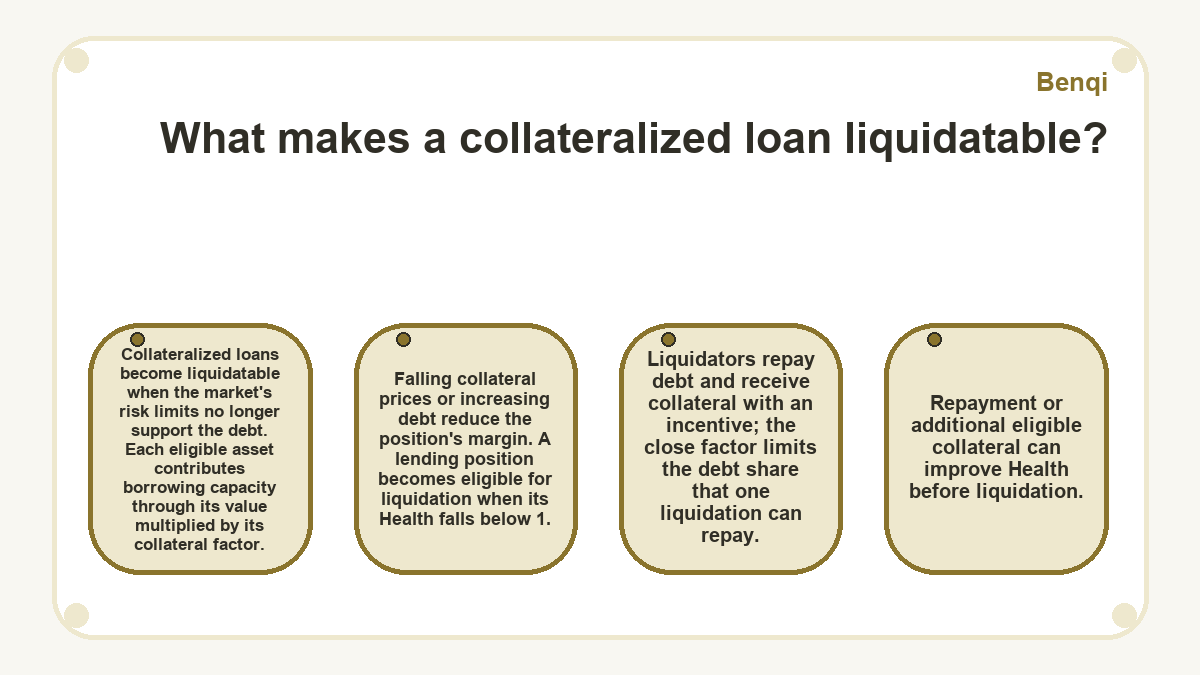
Collateralized loans become liquidatable when the market's risk limits no longer support the debt. Each eligible asset contributes borrowing capacity through its value multiplied by its collateral factor. Falling collateral prices or increasing debt reduce the position's margin. A lending position becomes eligible for liquidation when its Health falls below 1. Liquidators repay debt and receive collateral with an incentive; the close factor limits the debt share that one liquidation can repay. Repayment or additional eligible collateral can improve Health before liquidation.
Ignite separates validator capital from operating costs
Ignite's Pay-As-You-Go (PAYG) option supplies the 2000 AVAX stake used for an Avalanche Primary Network validator. The operator pays a rental fee upfront for a selected staking period and receives no staking rewards from the rented AVAX. The 2000 AVAX supplied for validation is separate from the fees paid to rent it.
Hosting remains a separate operating cost, so a weekly rental quote excludes part of the expense of running the node. The chosen duration and payment method affect the amount charged. Validator operation also requires the correct node identity and signing details.
The Stake option uses QI alongside hosting fees to support automated validators and QI rewards. This differs from renting AVAX through PAYG. Its QI component also differs from staking AVAX for sAVAX: the assets, outputs and ongoing costs have different roles. Comparing QI rewards with hosting costs requires valuing both in the same currency.
QI and Miles influence validator delegation
Miles connect QI staking to the allocation of AVAX delegations. Flex, the implemented accrual model, builds Miles (previously called veQI) over time as QI stays staked. The QI that generates voting power and the AVAX that validators receive as delegation are different assets. Voting influences the placement of pool stake; it does not transfer that stake to a voter.
Under the 35/65 delegation arrangement, the Miles Pool receives 35% of delegations and the Open Pool 65%. Node Voting applies only to the Miles Pool. The Open Pool has separate eligibility and allocation rules.
Aggregate Miles votes influence a validator's chance of selection within the voted pool. Validator eligibility remains a separate requirement. Changes to delegation policy can alter how voting power translates into AVAX delegations.
Token liquidity and access to underlying capital differ
A transferable token can offer market liquidity while its underlying protocol position has a slower exit. For sAVAX, protocol redemption and a secondary-market swap are separate paths to AVAX. Redemption follows the protocol's cooldown and claim window. A swap uses the price and liquidity in the chosen market, and automated market maker fees may apply. The protocol's AVAX exchange rate does not dictate the amount that a secondary market will pay.
Outstanding debt, including accrued interest, constrains how much collateral can be withdrawn because the remaining eligible collateral must still meet market limits.
Contract permissions can change a position's operating conditions
Some lending and liquid staking contracts are upgradeable, so a position can continue under revised contract logic. Updates can change how deposits, withdrawals and other functions operate after capital enters the system.
Protocol parameters also depend on multisignature authorization. Distributing signing authority reduces the power of a single key. A compromised threshold of signers can still permit harmful changes to collateral factors, asset listings or staking-related functions.
Liquid staking additionally uses off-chain multiparty computation to move AVAX between Avalanche chains. Signing outages can halt staking, unstaking or transfers until enough nodes become available; a compromised signing threshold can threaten staked assets.
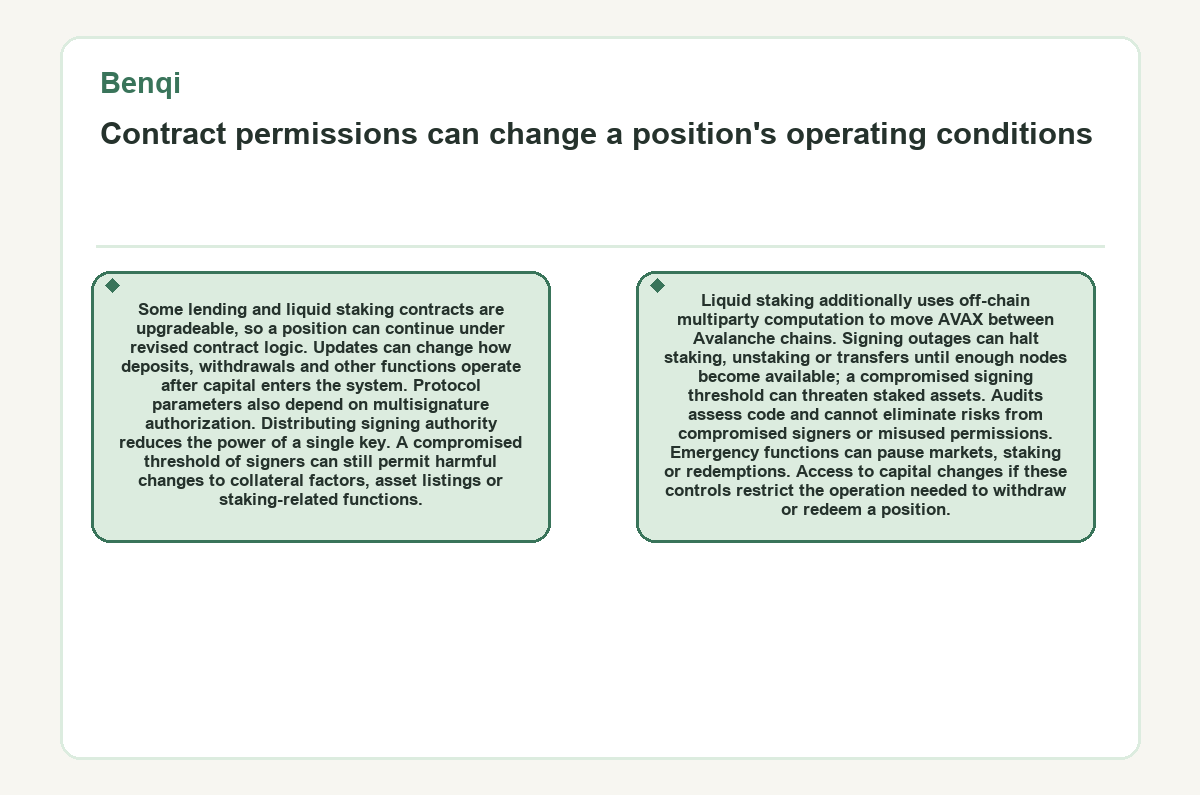
Audits assess code and cannot eliminate risks from compromised signers or misused permissions. Emergency functions can pause markets, staking or redemptions. Access to capital changes if these controls restrict the operation needed to withdraw or redeem a position.
Frequently asked questions about Benqi
Do I need to bridge AVAX to the P-Chain before using liquid staking?
Liquid staking accepts AVAX on Avalanche's C-Chain and handles the transfer to the P-Chain within its infrastructure. You receive sAVAX on the C-Chain. Manual bridging is unnecessary for this staking route, although the underlying AVAX still participates in P-Chain staking and relies on the protocol's cross-chain infrastructure.
How long is the sAVAX redemption window after unstaking?
The standard protocol route uses a 15-day cooldown followed by a 2-day redemption window. Staking rewards continue during the cooldown and stop during the redemption window. This schedule concerns protocol unstaking; a secondary-market sale follows market pricing and liquidity. Emergency restrictions can affect access to protocol redemption.
Can an Ecosystem Market loan be repaid with another token?
Avalanche Ecosystem Market loans support repayment using multiple ERC-20 tokens when sufficient liquidity exists. The borrowed asset remains USDC. Permission to repay with another token does not make that token a borrowing option, and repayment flexibility depends on the token and liquidity supported for that operation.
Which tokens can pay an Ignite PAYG fee?
Ignite PAYG fees can be paid in AVAX, USDC or QI. These are payment choices for the rental model. Using QI for payment does not by itself select the QI Stake validator option. The fee also depends on the chosen staking period.
Will withdrawing only part of my staked QI preserve my Miles?
Under Flex, unstaking any amount of QI resets the user's entire accumulated Miles balance to zero. Leaving some QI staked does not preserve a proportional share of the previous voting power. This condition concerns QI unstaking, which is separate from redeeming sAVAX for AVAX.
May I split my Miles votes among several validators?
Miles voting power can be allocated to one validator or split among multiple validators. These allocations support delegation decisions within the Miles Pool. They do not change how the separate Open Pool allocates its AVAX, and a vote does not promise a fixed delegation.
Is the Lock option available for earning Miles immediately?
Lock is a planned option, while Flex is the implemented Miles accrual model. The proposed Lock arrangement pairs immediate Miles accrual with a delayed exit. Flex instead accumulates Miles gradually as QI stays staked; the planned option should not be treated as an available source of instant voting power.
Does the reserve factor apply to my entire deposit?
The reserve factor allocates a share of borrower interest to protocol reserves. Changing that factor changes how borrower interest is allocated; it does not create an equivalent percentage charge on every depositor's principal.