Benqi liquid staking, sAVAX value and exit routes
Updated:
Benqi liquid staking converts AVAX into sAVAX, a transferable token whose AVAX value incorporates staking rewards. Holding the token preserves exposure to those rewards, while returning to AVAX involves a choice. Direct redemption follows an unstaking schedule. A secondary-market swap exchanges sAVAX at an available market price, with liquidity and execution costs determining the amount received.
The token count, its protocol conversion rate and a swap quote describe different parts of the position. Keeping those quantities separate explains both a balance that stays unchanged and an exit that returns a different amount than a wallet valuation.
An sAVAX balance can stay unchanged while its AVAX value grows, and an exit still depends on redemption timing or market liquidity.
Rewards accumulate in the AVAX value of sAVAX
AVAX delegated through the liquid staking pool earns validator rewards, which increase the AVAX represented by each sAVAX token as the pool accounts for them. Reward accrual alone does not increase the number of sAVAX tokens in a wallet. An unchanged token balance can therefore represent a growing amount of underlying AVAX.
The pool's accounted AVAX divided by its outstanding sAVAX gives the AVAX value per token. Multiplying that rate by a holding expresses its underlying AVAX value before exit costs. The displayed annual percentage rate, or APR, describes an annualized staking return in AVAX. It is separate from an achieved return over a particular holding period and from changes in AVAX's currency price.
The cooldown comes before the claim window
Direct sAVAX redemption follows a 15-day unstaking cooldown under the liquid staking schedule. Rewards continue accruing during that waiting period. A subsequent two-day redemption window allows the eligible AVAX claim, with the AVAX claim amount based on the exchange rate applicable when the cooldown ends. Starting an unstake does not provide immediate spending access to its AVAX.
Those periods are configurable protocol parameters. A request's timing follows the applicable cooldown and redemption settings, while a pause or operational disruption can affect redemption access.
An expired window leaves sAVAX held for the overdue request recoverable through the contract's overdue-share function. Recovery returns sAVAX; it does not complete an AVAX withdrawal. A later protocol exit needs another unlock request under the applicable timing rules. The limited claim window therefore requires attention even when there is no immediate need for the funds.
How does a market swap change the exit?
A market swap exchanges sAVAX for AVAX without waiting through the protocol cooldown, provided an available pool can execute the trade. Its output follows the market quote. Direct redemption uses the protocol's redemption accounting and timing. Holding sAVAX remains another option when spending AVAX is unnecessary.
| Position choice | Access condition and exposure |
|---|---|
| Hold sAVAX | Retains staking exposure through the token; underlying AVAX remains subject to an exit route. |
| Redeem through liquid staking | Requires an eligible claim window and functioning redemption operations. |
| Swap sAVAX for AVAX | Requires available market liquidity and accepts the executing pool's pricing and contract exposure. |
Minted token counts follow the conversion rate
An AVAX deposit mints sAVAX at the pool's conversion rate, so the input and output token counts need not match numerically. When each sAVAX represents more AVAX, a deposit produces fewer sAVAX units than AVAX units supplied. Comparing the output's underlying AVAX value with the deposit explains the conversion without treating the token-count difference as a separate charge.
Deposits and sAVAX balances use Avalanche's C-Chain. The protocol delegates underlying AVAX on the P-Chain through cross-chain infrastructure, allowing a transferable C-Chain token to represent AVAX committed to network validation.
What costs affect an sAVAX exit?
Exit costs include network fees and, for market swaps, pool fees and execution pricing. Benqi liquid staking lists no separate protocol fee for staking, depositing or withdrawing AVAX.
The liquid staking revenue model allocates 10% of validator rewards to Benqi. This percentage applies to rewards, leaving deposited principal outside that calculation. The reward allocation and a withdrawal transaction's network cost have different bases. Neither establishes a fixed AVAX charge for every exit.
C-Chain transactions need native AVAX for fees, with costs depending on gas requirements and applicable fee conditions. For a swap, the input size and available liquidity also affect execution. A larger trade can move further through a pool's pricing curve. The amount quoted for one size therefore cannot establish the proceeds for another size.
Protocol value and a market quote measure different things
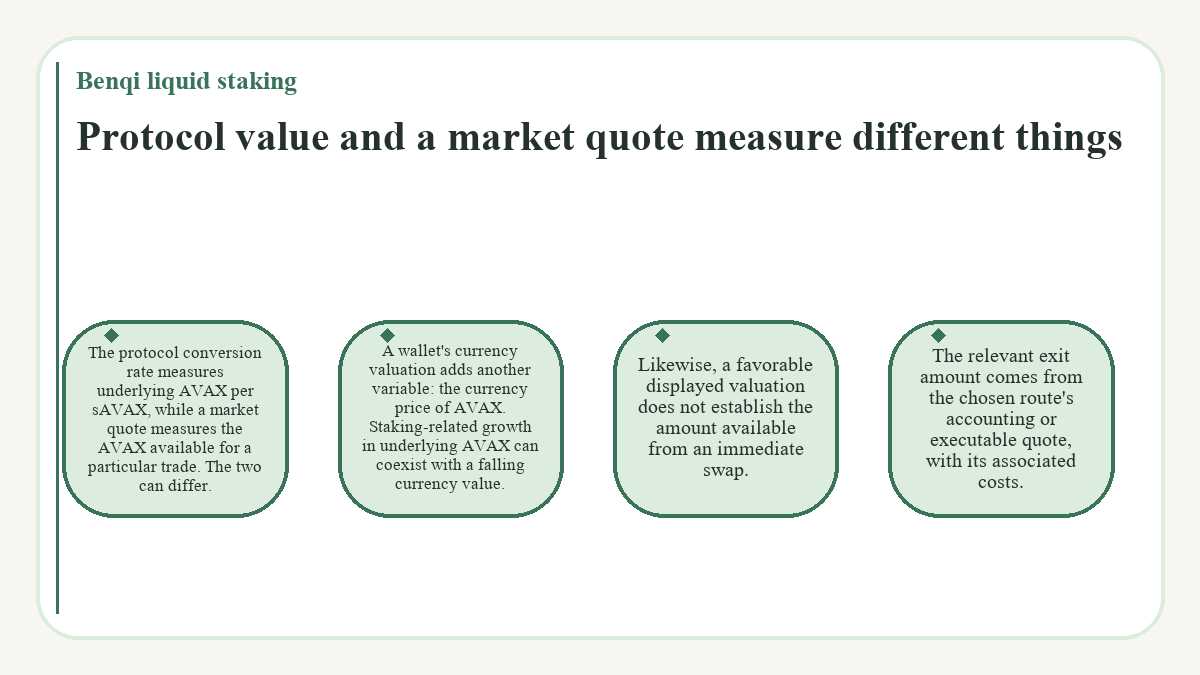
The protocol conversion rate measures underlying AVAX per sAVAX, while a market quote measures the AVAX available for a particular trade. The two can differ. A wallet's currency valuation adds another variable: the currency price of AVAX. Staking-related growth in underlying AVAX can coexist with a falling currency value. Likewise, a favorable displayed valuation does not establish the amount available from an immediate swap. The relevant exit amount comes from the chosen route's accounting or executable quote, with its associated costs.
Using sAVAX in lending changes withdrawal access
Supplying sAVAX to Benqi Markets adds a lending position with its own access conditions, while the underlying token retains its staking-related value accrual. Any lending interest or QI incentive belongs to that market's terms. Holding sAVAX alone does not establish eligibility for every additional reward. The staking return and a market incentive should remain separate when evaluating the position.
Using the supplied token as collateral introduces borrowing and liquidation conditions. Withdrawing it then depends on the lending position's remaining collateral and debt obligations. Staking-related appreciation does not remove those constraints. An sAVAX balance committed to another contract also cannot simultaneously serve as freely spendable wallet inventory for an exit.
Audit scope and operating permissions
The liquid staking contracts have a Halborn audit covering November 2021 through February 2022 and Certora formal verification dated April 2022. These assessments concern particular code and properties.
Upgradeable contracts and multisig permissions can change staking or withdrawal behavior. Emergency functions can interrupt redemption. Audits assess code within their scope; signer compromise and misuse of authorized functions create separate risks. These powers affect access even when a position otherwise meets its timing conditions.
Cross-chain transfers also rely on off-chain multi-party computation infrastructure. A signing-threshold compromise can misdirect assets, while insufficient available signing nodes can halt operations. Token transferability does not remove these dependencies from the underlying AVAX. A secondary-market exit introduces its executing contracts as additional dependencies.
A claim record distinguishes payment from a pending request
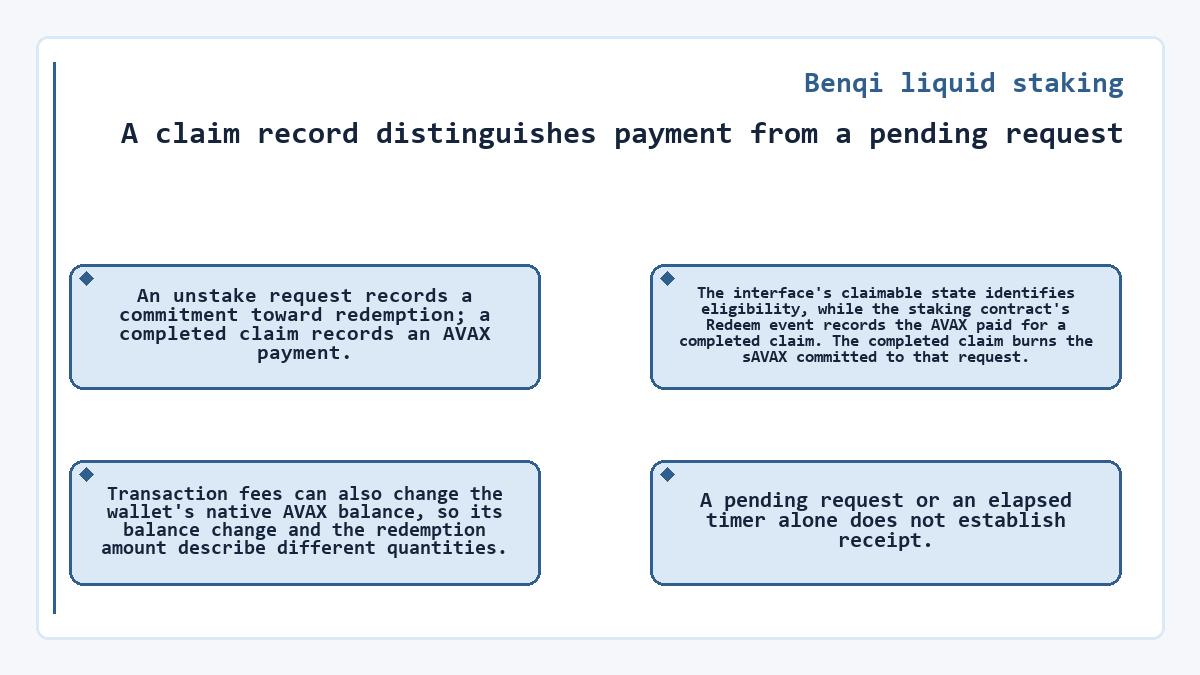
An unstake request records a commitment toward redemption; a completed claim records an AVAX payment. The interface's claimable state identifies eligibility, while the staking contract's Redeem event records the AVAX paid for a completed claim. The completed claim burns the sAVAX committed to that request. Transaction fees can also change the wallet's native AVAX balance, so its balance change and the redemption amount describe different quantities. A pending request or an elapsed timer alone does not establish receipt.
Benqi liquid staking: frequently asked questions
-
May I redeem sAVAX from a wallet that never deposited AVAX?
- A wallet holding transferable sAVAX can request redemption without having made the original AVAX deposit. The token carries the staked position, and the request uses the requesting wallet's sAVAX balance. The applicable cooldown, claim window and operational restrictions still govern that redemption.
-
Does transferring sAVAX move an existing unstake request?
- An existing unstake request remains associated with its requesting address and the sAVAX that the contract holds separately for it, so transferring other sAVAX from the wallet does not move that request or its AVAX claim rights to the recipient.
-
Can I cancel an unstake request during its cooldown?
- The staking contract supports cancellation of an unexpired unlock request when its required operations are not paused. Cancellation releases the committed sAVAX instead of paying AVAX. An expired request uses the separate overdue-share recovery mechanism.
-
Are sAVAX tokens burned when I claim AVAX?
- The redemption contract automatically burns the sAVAX corresponding to a successful AVAX redemption. Holding the token does not require a separate burn operation. Sending it away or approving another contract to spend it does not itself perform redemption.
-
Where can software read an sAVAX balance's underlying AVAX value?
- The staking contract exposes getPooledAvaxByShares to convert an sAVAX share amount into its underlying AVAX value. This read describes the protocol conversion, so it is useful for balance accounting. It does not supply an executable market quote or replace a pending request's redemption accounting.
-
Why can a very small AVAX deposit fail to mint sAVAX?
- A deposit can fail if integer conversion rounds its output down to zero sAVAX shares. That is a precision constraint rather than evidence of a universal minimum deposit quoted in whole AVAX. Transaction funding and other contract restrictions can also prevent minting.
-
Do I need QI to earn the staking return carried by sAVAX?
- Holding sAVAX provides exposure to its AVAX staking accrual without a separate QI stake. QI staking and Miles-based validator voting have different participation rules. Receiving sAVAX does not itself establish a QI staking position or allocate validator votes.