Benqi lending from deposit to account balance
Updated:
Benqi lending credits supported Avalanche deposits to an interest-bearing market balance. The supply transaction moves an asset from the funding wallet into its selected market. In Core Markets, qiTokens represent the resulting claim on that asset. Enabling collateral can make eligible deposits support borrowing, while a supply alone creates no loan. A signed request still needs successful execution and a credited position. Withdrawal later depends on available market liquidity and, where relevant, the collateral needed for outstanding debt.
In short: An unchanged qiToken count can represent growing lending interest because each receipt token converts through the market's exchange rate.
Wallet assets, supply claims and borrowing capacity
When a deposit will support borrowing, the supplied asset must qualify as collateral in the selected market. Wallet balances cover the supplied asset and network fees. The supply claim tracks what the market owes the account, while collateral settings determine its contribution to borrowing capacity. Any loan adds a separate debt balance. Account health reflects the relationship between eligible collateral and debt, so depositing, enabling collateral and borrowing have different effects. A deposit's interest-bearing balance does not establish how much the account can borrow.
Asset ownership and permission before supplying
The funding account and exact asset
The funding account needs the supported asset on Avalanche C-Chain before a supply can use that balance. For an ERC-20 asset, match the token contract to the selected market's underlying asset, especially when similar symbols represent different tokens on Avalanche. Connecting another account does not move its tokens. Keep AVAX available for transaction fees, including when supplying an ERC-20 token. The network fee varies with transaction execution and network conditions; it is separate from the amount credited to the lending position.
ERC-20 allowance and native AVAX
For a direct Core Market ERC-20 supply, the market pulls tokens using the owner's spending allowance. An insufficient allowance requires approval before that transfer can succeed. Review the permitted token, spender and amount before authorizing it. Approval alone creates no supply balance. Native AVAX follows the payable supply function and does not need an ERC-20 allowance. Its deposit value and transaction fee both require AVAX in the funding account.
Supply submission and the credited position
A deposit counts as supplied after the market executes the supply operation and credits the account's position.
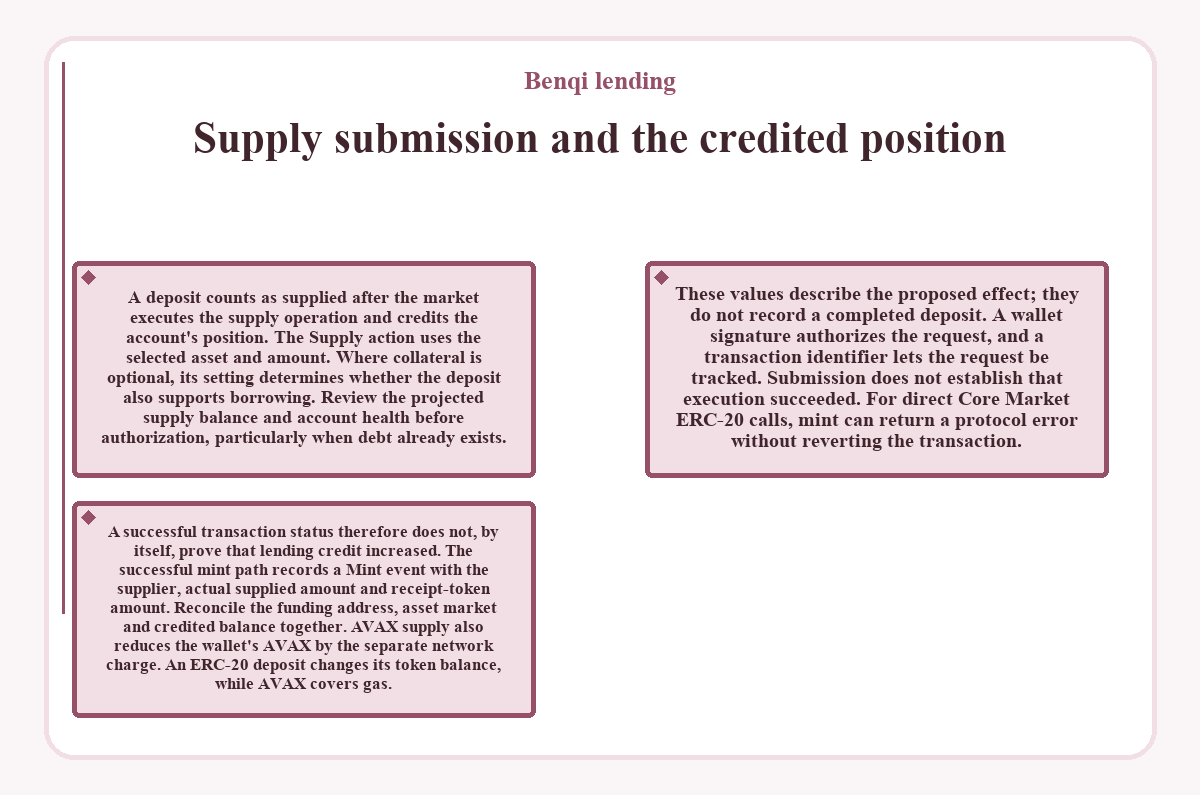
The Supply action uses the selected asset and amount. Where collateral is optional, its setting determines whether the deposit also supports borrowing. Review the projected supply balance and account health before authorization, particularly when debt already exists. These values describe the proposed effect; they do not record a completed deposit.
A wallet signature authorizes the request, and a transaction identifier lets the request be tracked. Submission does not establish that execution succeeded.
For direct Core Market ERC-20 calls, mint can return a protocol error without reverting the transaction. A successful transaction status therefore does not, by itself, prove that lending credit increased. The successful mint path records a Mint event with the supplier, actual supplied amount and receipt-token amount.
Reconcile the funding address, asset market and credited balance together. AVAX supply also reduces the wallet's AVAX by the separate network charge. An ERC-20 deposit changes its token balance, while AVAX covers gas.
Interest accounting behind the displayed balance
Receipt units and asset units
In Core Markets, the qiToken balance converts to an underlying-asset balance through the market's exchange rate. That rate expresses underlying units per receipt token after decimal scaling. Multiplying the receipt balance by the normalized rate gives its underlying value. Interest can increase that value while the receipt-token count stays unchanged. Raw contract integers need correct decimal scaling before multiplication. A stored exchange-rate read can lag interest accrual; exchangeRateCurrent updates interest before returning the rate.
Market interest and separate incentives
Supply rates respond to asset-market utilization through the interest-rate model. The reserve factor directs a share of borrower interest to protocol reserves, and the supply-rate calculation already accounts for that allocation. QI incentives follow a separate rewards arrangement whose parameters can change. They should remain separate from the supplied underlying amount when reconciling balances. An asset's currency price can also change its displayed value without changing its token quantity. For supplied sAVAX, its staking-related AVAX value remains distinct from the lending account's balance measured in sAVAX.
An unchanged qiAVAX count with a larger AVAX claim
An unchanged receipt balance can still represent accrued lending interest. In this hypothetical Core Markets example, the deposit is 14.42 AVAX. The normalized entry exchange rate is 0.028 AVAX per qiAVAX, and a later rate is 0.029 AVAX per qiAVAX. Assume no starting qiAVAX balance, further deposits, withdrawals or receipt transfers.
The initial receipt amount is 14.42 ÷ 0.028 = 515 qiAVAX. At the later rate, 515 × 0.029 = 14.935 AVAX. The unchanged receipt count therefore represents an additional 0.515 AVAX.
The increase is lending value denominated in AVAX; the calculation excludes gas costs and any QI incentives. Neither exchange rate supplies a time interval, so these inputs cannot establish an annual yield. Withdrawal still depends on liquidity and collateral requirements.
Core and Ecosystem balances have different scopes
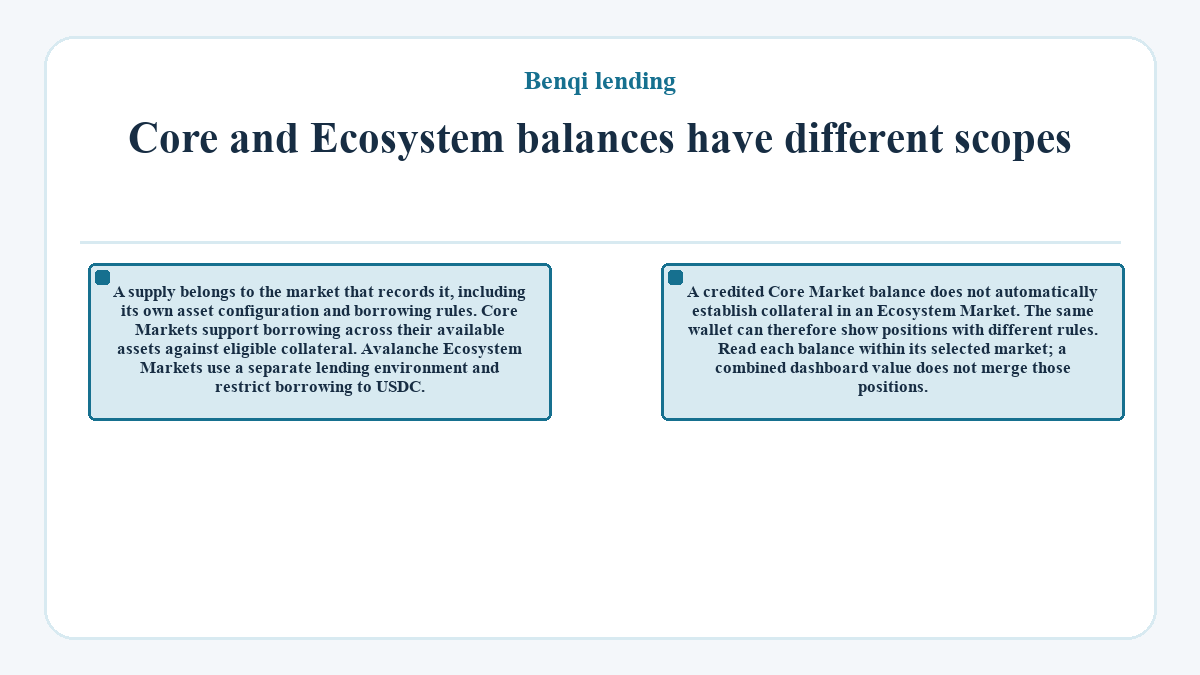
A supply belongs to the market that records it, including its own asset configuration and borrowing rules. Core Markets support borrowing across their available assets against eligible collateral. Avalanche Ecosystem Markets use a separate lending environment and restrict borrowing to USDC. A credited Core Market balance does not automatically establish collateral in an Ecosystem Market. The same wallet can therefore show positions with different rules. Read each balance within its selected market; a combined dashboard value does not merge those positions.
Withdrawal access follows liquidity and collateral
Underlying cash available for redemption
A Core Market redemption requires enough available underlying cash to cover the requested withdrawal. The total assets represented by supply claims include funds currently lent to borrowers. That total therefore differs from the cash immediately available for redemption. A credited claim can remain intact while an oversized withdrawal fails the cash check. A smaller withdrawal may pass the cash check, while the original amount needs more liquidity.
Collateral remaining after withdrawal
When supplied assets back debt, a withdrawal must also leave sufficient eligible collateral for the remaining loan. Falling collateral prices or growing debt can reduce that allowance. If the account falls below its collateral requirement, a liquidator can repay part of its debt and seize collateral. Repaying debt or adding eligible collateral can improve the position's health. Neither action guarantees that the particular asset market has enough cash for a withdrawal. In Core Markets, removing a market from collateral use also requires no outstanding borrow in that asset.
A completed redemption reduces the supply claim and returns the underlying asset to the wallet.
Benqi lending - common questions
Can I transfer qiTokens without first withdrawing the underlying asset?
Core Markets qiTokens can transfer between wallets when the contract's transfer and collateral checks permit the move. A transfer that would leave the sending account short of required collateral is rejected. Moving receipt tokens also leaves any existing debt with the original borrower, so it cannot serve as a loan transfer.
Does disconnecting my wallet interrupt lending interest?
Disconnecting a wallet does not withdraw its deposit or stop protocol interest accrual. The lending position belongs to the account recorded by the contracts, regardless of whether a browser remains connected. The same account's balances remain the relevant records when it reconnects; closing a browser does not perform redemption or repay an outstanding loan.
Will a normal ERC-20 transfer credit my lending account?
An ordinary ERC-20 transfer does not call the supply function that credits the sender's lending position. In the direct Core Markets flow, mint pulls the approved underlying token and records the receipt balance. Seeing a transfer to the market's address therefore establishes token movement, without establishing that a supply position was credited.
Which amounts do redeem and redeemUnderlying accept?
In Core Markets, redeem takes a qiToken amount, while redeemUnderlying takes an amount of the underlying asset. Both take raw integer amounts scaled by the decimals of the corresponding asset. Those inputs express different withdrawal targets; neither function bypasses liquidity or collateral checks.
Do revoked token permissions remove my existing deposit?
Revoking an ERC-20 spending allowance does not redeem an existing supply or erase debt. The permission controls whether its specified spender can pull more tokens from the wallet. Funds already supplied remain in the market's accounting. Withdrawing that supply and repaying a loan require the operations that change those recorded balances.
When can a Core Market reject a new supply?
A Core Market can reject additional supplies when its mint pause is active. That control prevents the supply operation from proceeding; it does not remove existing qiToken balances. An asset appearing in an account or a market list therefore does not establish that a new deposit will currently succeed.