Benqi Ignite combines validator funding with separate hosting costs
Updated:
Benqi Ignite advertises Pay As You Go (PAYG) funding from 8 AVAX per week, with additional hosting costs for the validator. The service supplies the 2000 AVAX required for the validator stake, while the operator pays the selected term's fee upfront. A separate Stake option involves committing QI and covering hosting costs where that option is available. The choice changes the capital committed and the rewards attached to the arrangement. A useful operating budget therefore includes the registration charge, hosting and network transaction fees.
The short version: PAYG's QI discount reduces the service fee, while Stake involves committed QI and a separate reward arrangement.
PAYG and Stake put capital to different uses
PAYG funds validation without the operator supplying the full AVAX stake. Stake commits QI alongside a reward arrangement and hosting costs.
PAYG purchases access for a selected term
The PAYG fee pays for access to validator capital during the selected rental period. It is an operating expense. The supplied 2000 AVAX backs network validation. The operator's budget concerns service payments and node expenses. PAYG's rental terms exclude AVAX staking rewards for the user, so those rewards should not fund the projected budget.
Stake commits QI alongside hosting costs
The QI-based Stake option supports automated validators and QI rewards. Committed tokens remain a capital exposure, while hosting remains a service cost. Where Stake is offered, its QI commitment, hosting quote and any applicable registration fee determine the funds needed.
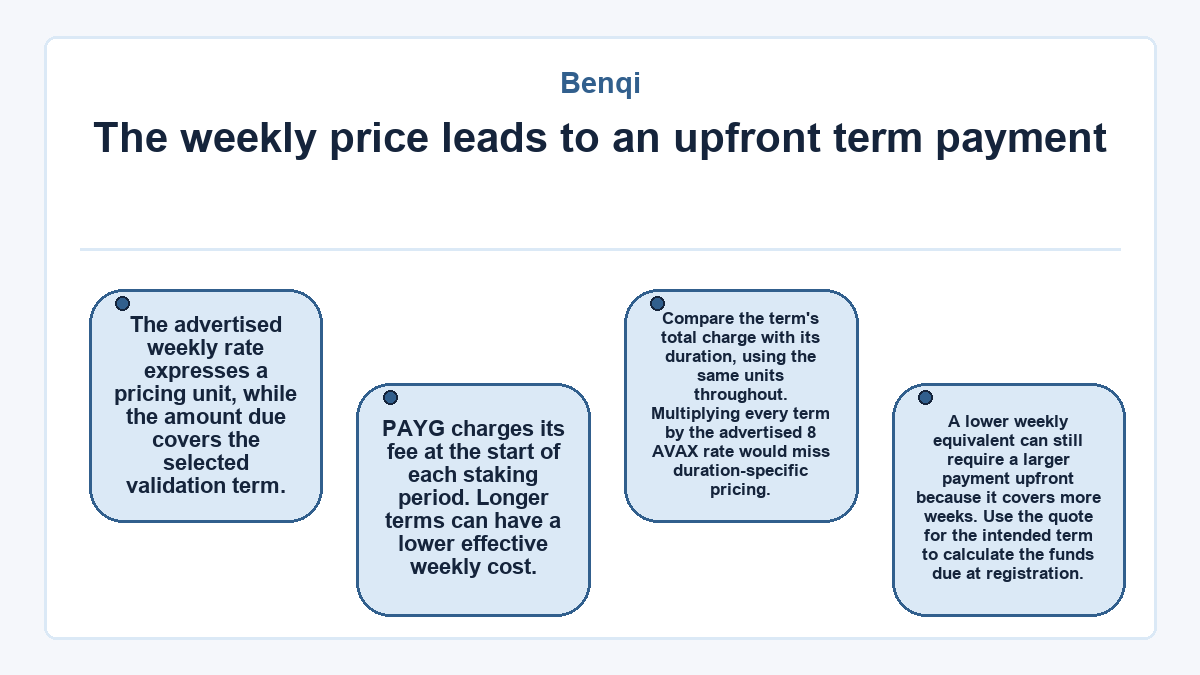
The weekly price leads to an upfront term payment
The advertised weekly rate expresses a pricing unit, while the amount due covers the selected validation term. PAYG charges its fee at the start of each staking period. Longer terms can have a lower effective weekly cost. Compare the term's total charge with its duration, using the same units throughout. Multiplying every term by the advertised 8 AVAX rate would miss duration-specific pricing. A lower weekly equivalent can still require a larger payment upfront because it covers more weeks. Use the quote for the intended term to calculate the funds due at registration.
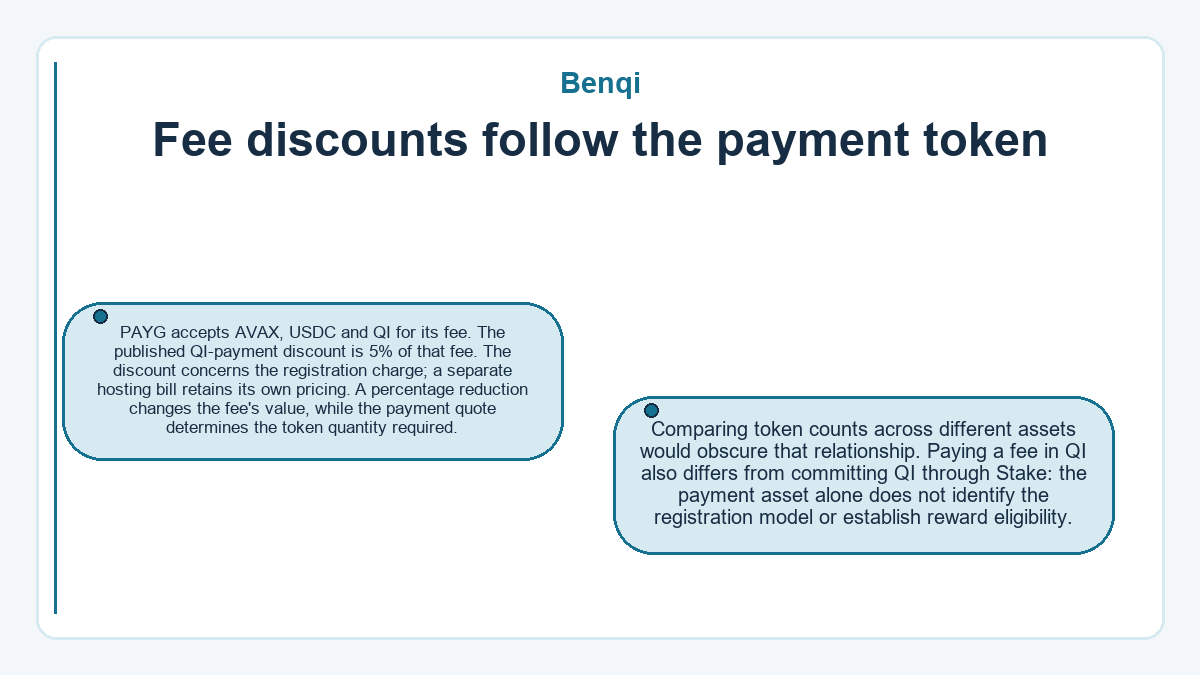
Fee discounts follow the payment token
PAYG accepts AVAX, USDC and QI for its fee. The published QI-payment discount is 5% of that fee.
The discount concerns the registration charge; a separate hosting bill retains its own pricing. A percentage reduction changes the fee's value, while the payment quote determines the token quantity required. Comparing token counts across different assets would obscure that relationship. Paying a fee in QI also differs from committing QI through Stake: the payment asset alone does not identify the registration model or establish reward eligibility.
Hosting and network fees need separate allowances
An Ignite budget includes both validator funding and the cost of running the node. Removing the large AVAX stake requirement leaves operating expenses payable.
Hosting covers the running node
Hosting pays for the infrastructure that keeps the validator running. Its charge belongs beside the funding fee when comparing arrangements. Preserve the provider's billing period and currency in the calculation. A weekly validator-capital price and a differently billed hosting service need a common time basis before their totals can be compared. If a quoted total already includes hosting, adding the same charge again would overstate the required funds.
Network fees cover transactions
Avalanche C-Chain transactions require AVAX for network fees, including when a service fee uses another token. The network charge varies with transaction execution and fee conditions. Use an estimate for the intended transaction in the AVAX funding calculation. A wallet holding enough QI or USDC for the service payment can therefore still lack the AVAX needed for its transaction.
Node readiness comes before a funding commitment
PAYG registration depends on node information as well as an affordable fee. The required information includes the Node ID and BLS ID code. PAYG registration also requires the node's BLS signature. These details identify the intended validator and support node verification.
The Node ID and BLS details need to belong to the validator covered by the selected registration. Missing node information leaves a prerequisite unresolved even when the fee fits the available balance. Obtain any missing node details before paying for PAYG registration.
A four-week estimate leaves a measurable hosting allowance
In this hypothetical budget, an operator sets aside 37 AVAX and has the required node details ready. Use the published four-week PAYG pricing illustration of 30 AVAX as the fee input. That illustration supplies a calculation basis, not a confirmed live quote.
The balance appears sufficient for the rental fee. The remaining amount is 37 AVAX minus 30 AVAX, which equals 7 AVAX. Across four weeks, the illustrated fee averages 7.5 AVAX per week. Neither result assigns a price to hosting.
Before paying, review the selected term and its current quote. With an unchanged 30 AVAX fee, this budget covers all charges only if hosting and transaction costs together fit within the remaining 7 AVAX.
If the quote changes before payment, replace 30 AVAX with the new fee and recalculate the remainder before committing funds. If hosting and gas exceed that remainder, the registration is not fully funded. If the selected term, current fee and other charges fit the balance, the operator has enough for the quoted costs before registration.
QI rewards and hosting costs need a common valuation basis
QI rewards are token income. Comparing them with a hosting bill requires a matching period and a common valuation unit.
The committed QI balance also has its own market value. Separate that capital exposure from the service fees consumed during operation. Adding the entire stake to expenses would blur the difference between committed capital and spending. Subtracting projected rewards from charges due before those rewards arrive would blur the difference between future income and available funding.
Cancellation depends on the hosted implementation and provisioning state
Cyfrin's Ignite audit, version 2.0, dated December 11, 2024, describes specific cancellation conditions for a Zeeve-hosted QI-staking implementation. Those conditions concern that implementation rather than every Ignite payment.
Cancellation before provisioning
In the audited implementation, refund execution requires the configured waiting period since staking to have elapsed and the validator to remain unprovisioned. Changes to the global refund period also affect existing stakes. A designated administrator executes the refund, so the request alone does not complete repayment.
Failed node registration
The same implementation distinguishes failed registration from voluntary cancellation. Its described recovery involves an authorized release before the QI stake becomes redeemable. Cyfrin verified fixes that leave the Ignite fee refundable after failed registration and exclude QI rewards from that failure path.
Liquid staking and lending have different accounting roles
Liquid staking exchanges AVAX for sAVAX, while lending supplies assets to a market that can pay interest. Those activities differ from purchasing validator funding or committing QI through Ignite. Their balances and income belong to their own positions. An Ignite estimate needs the capital and charges attached to its selected registration, with unrelated yield kept separate. The hosting payment needs spendable funds when the bill falls due.
Common questions about Benqi
Which rental durations appear in the PAYG registration instructions?
The documented PAYG choices are 2, 4, 8 and 12 weeks. A weekly price is a comparison unit for those terms; it does not establish a daily rental tariff. The selected duration determines which term quote belongs in the cost estimate.
Where can I obtain the BLS details needed before paying for PAYG registration?
The BLS details come from the node's configuration or its cloud platform during validator setup. The registration instructions request a BLS ID code and BLS signature alongside the Node ID. Have the required details ready before paying for PAYG registration.
Can paying an Ignite fee secure Node Voting delegations?
An Ignite payment does not establish an allocation through Node Voting. That mechanism uses Benqi Miles votes to influence a designated part of the liquid staking pool's delegations. Potential delegation income therefore needs its own applicable conditions and should remain separate from the fee-funded validator budget.
Does the hosted Stake implementation collect hosting fees before QI rewards arrive?
The hosted QI-staking implementation examined in Cyfrin's December 11, 2024 Ignite audit collects the hosting charge during the initial staking step. QI rewards relate to subsequent validation. This payment order concerns that implementation, so projected rewards do not supply its initial hosting payment.